
How to Plan Your 2027 Compliance Training Concept
Plan 2027 compliance training in seven steps: map obligations to roles, add a live layer for regulatory change, and get ready for the AI Act's 2027 deadline.
In short
- Start with regulatory obligations, not courses
- Make training role-specific
- Build a flexible training programme
- Prioritise evidence and engagement
- Plan and budget for continuous change
Contents
- Why 2027 is a different planning year
- Start with an obligations register, not a course catalogue
- Map every obligation to the roles it touches
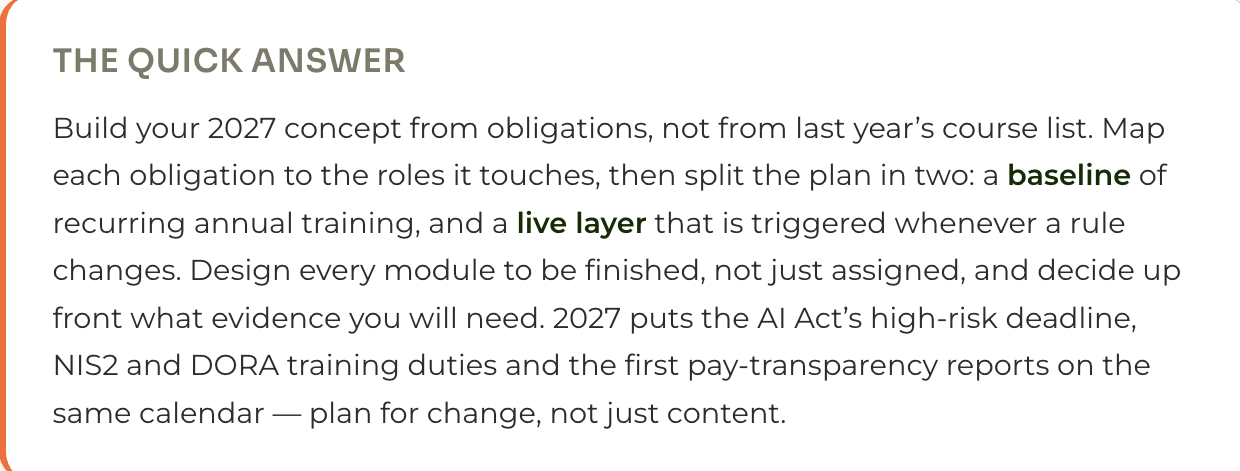
- Split the plan into a baseline and a live layer
- Design for completion, not coverage
- Decide what evidence you will need — before you build
- Budget for change, not just content
- Review quarterly, against the register
- Where Lexstream fits
Why 2027 is a different planning year
The traditional training plan assumes the rules stand still for twelve months. Several European regimes that touch ordinary staff — not just specialists — reach operational maturity at the same time, and at least one of them changed shape mid-flight.
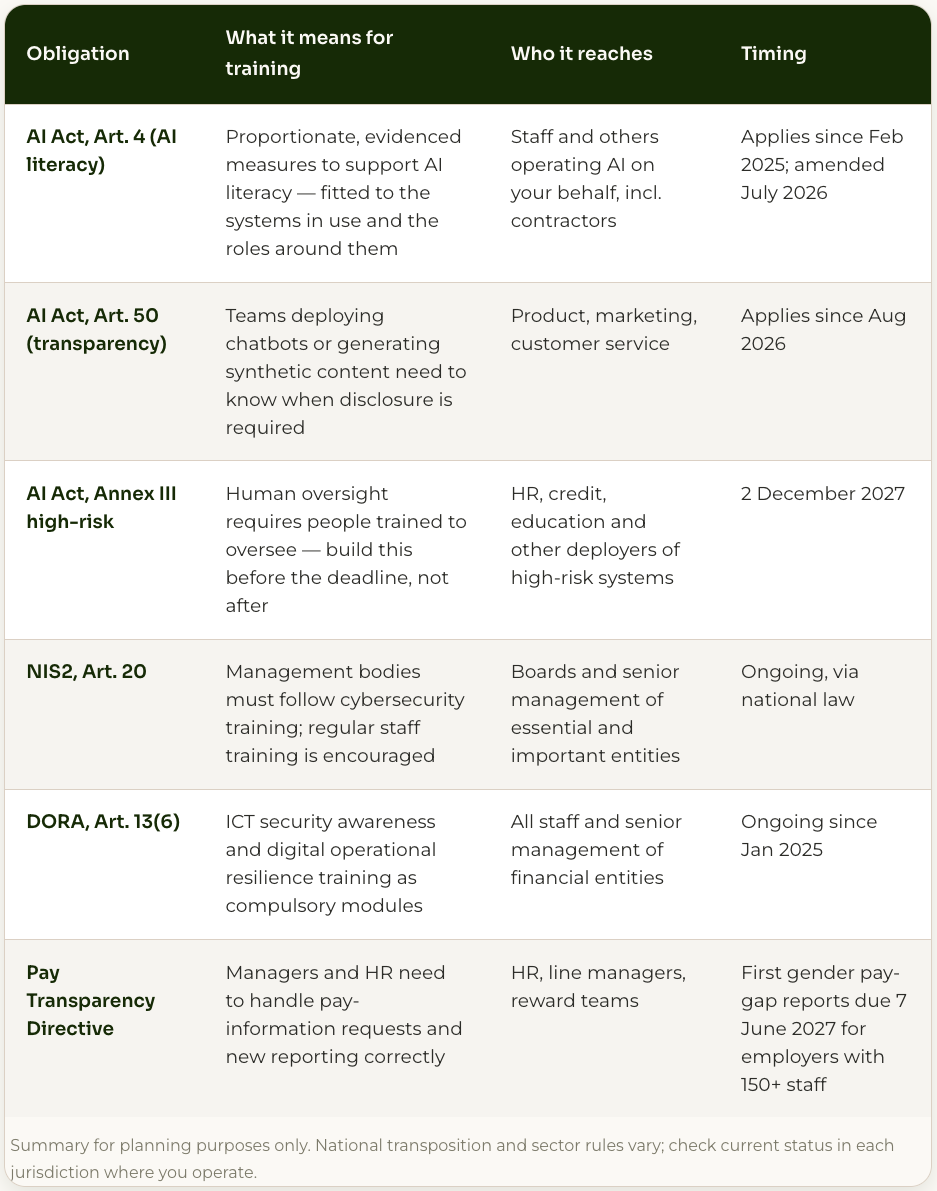
The clearest example is the EU AI Act. The Digital Omnibus on AI, Regulation (EU) 2026/1744, entered into force on 27 July 2026. It moved the high-risk obligations for stand-alone Annex III systems — recruitment, credit scoring, education and others — from August 2026 to 2 December 2027. It also rewrote Article 4 on AI literacy: the duty moved from ensuring a sufficient level of literacy to taking measures to support its development. That reads like a relaxation. In practice it is a documentation duty: you no longer have to guarantee what each person knows, but you do have to show what you did.
Plans written against the original AI Act timeline are now describing a text that no longer exists. That is the 2027 problem in miniature: a training concept is only as good as its last regulatory update.
Start with an obligations register, not a course catalogue
Start with last year’s course list, and you risk planning last year’s training. Instead, list the obligations that apply to you in 2027 — regulation, sector rules, internal policy — and note for each one whether it requires training explicitly, implicitly (as with human oversight) or not at all. Courses come later; they are the output, not the input.
Map every obligation to the roles it touches
“All staff” is rarely the right audience. A board member needs NIS2 governance training; an HR partner needs pay-transparency handling; a developer needs Article 50. Map obligations to roles and jurisdictions, and remember the people outside your HR system: the AI Act’s literacy duty covers anyone operating AI systems on your behalf, which pulls contractors inside the scope.
Split the plan into a baseline and a live layer
This is the single most useful structural decision. The baseline is your recurring annual programme: code of conduct, data protection, anti-bribery and information security. It is predictable and can be scheduled a year ahead. Alongside it, establish a process for responding to change. When a new guideline is issued, a relevant judgment is handed down or a regulation is amended, assess what it means for your organisation, identify the roles affected and determine whether targeted training or guidance is needed. Set a clear response time — for example, briefing affected roles within 30 days of a material change — and treat this as an ongoing responsibility, not a one-off project.
Most programmes fail here. Monitoring without teaching produces alerts nobody acts on; teaching without monitoring produces courses that quietly go out of date.
Design for completion, not coverage
A module nobody finishes is a liability with a completion certificate. Keep units short enough for the window people actually have, deliver them in the languages your workforce speaks, and offer more than one format — video for the commute, audio for the car, interactive lessons for the desk. Comprehension checks should test application (“what do you do when…”) rather than recall.
Decide what evidence you will need — before you build
When an obligation becomes one of effort rather than result, the evidence is the compliance. For each obligation, decide now what you would show a regulator: who was trained, on which version of the material, when, and with what result. Version control matters most for the live layer, where the same topic may be updated several times in a year.
Budget for change, not just content
Annual budgets tend to fund a fixed number of new courses. That leaves nothing for the live layer. Hold back a share of production capacity — a fifth is a reasonable starting point — for updates you cannot yet name, and favour production methods where revising a module takes days rather than a re-shoot.
Review quarterly, against the register
Re-run step one every quarter. Which obligations changed? Which roles moved? Which modules are now out of date? A short quarterly review is cheaper than discovering in November 2027 that your high-risk AI oversight training was built for a text that was amended.
Where Lexstream fits
Step three is where most programmes need help, because it asks two different functions to work as one: someone has to notice what changed, and someone has to turn it into training people finish. In most organisations those live in different teams, different tools and different budgets.
Intelligence. Lexstream turns 500+ legal sources across 30+ jurisdictions into a single, jurisdiction-aware feed — classified and filtered to your practice, so the triggers for your live layer arrive on their own rather than through someone’s inbox.
Training. Lexstream Academy turns the same expertise into training your team can actually finish — short, designed for the few minutes people really have, and available in the languages they work in.
We’re honest about the boundary: Lexstream is not a GRC control engine or a whistleblowing hotline. If you need those, pair us with tools built for the job — our compliance software comparison covers the options.
General information, not legal advice.